
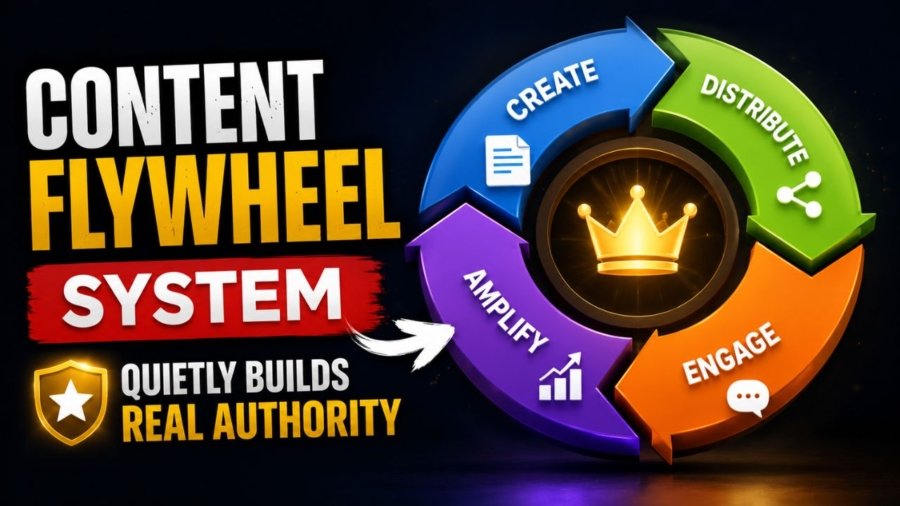
If you had to rebuild your entire online presence today, would you post more or post less? After years of building audiences across multiple platforms, the answer is surprising. Doing less, not more, is exactly what works in 2026. The secret is not effort, it is a well-designed content flywheel system that turns a small amount of work into a large amount of visibility.
Why Most Content Strategies Are Already Broken
Most creators sit down every single day and ask a dangerous question. What should I post today? Monday brings a LinkedIn idea. Tuesday brings a TikTok trend. Wednesday brings an Instagram post pulled out of thin air.
Every piece gets written from scratch, in the moment, with no connection to anything before it. Nobody can sustain that pace for long.
The real mistake happens before the content is even created. People treat a single post as the core unit of strategy. In truth, the idea is the real unit. A post is simply one format that idea takes.
Once this mindset shifts, the pressure changes completely. Instead of chasing sixty new ideas a month, you only need four strong ones.
Building the Foundation Before You Ever Hit Record
Four good ideas only work if they all point toward the same message. If Monday talks about automation, Tuesday talks about productivity, and Wednesday drops a random opinion, no algorithm can understand who you are. Neither can your audience.
This is why authority positioning matters so much, and it is the exact step most creators skip entirely.
Step One: Define Your Authority Statement
Your authority statement is one clear sentence describing who you help, what you help them achieve, and what makes your perspective different. This single sentence becomes a filter for every future idea. If new content does not support it, it gets cut immediately.
Step Two: Choose Your Content Pillars
Content pillars are three to five subtopics sitting underneath your authority statement. They act as buckets that every future piece of content must fit inside. Too few pillars and you run out of things to say. Too many and your audience becomes confused about your focus.
Step Three: Rotate Three Content Jobs
Every piece of content should serve one specific purpose. Trust-building content shares personal stories and honest opinions. Reach content delivers bold or surprising ideas designed to attract new audiences. Useful content offers practical frameworks and step-by-step guidance.
Relying on only one of these jobs weakens the entire system. Purely useful content feels like a textbook. Purely trust-based content feels like personality with no substance. Purely reach-driven content creates one viral moment followed by an empty following.
How a Single Idea Becomes a Full Month of Content
Once your statement, pillars, and content rotation are locked in, the real multiplication begins. This is where the content flywheel system takes over completely.
One long-form video, recorded once, can become ten to sixteen separate pieces of content. Repeat that process four times a month, and one person can realistically produce forty to sixty pieces from just a few recording sessions.
This approach matters even more now because search itself has changed. Artificial intelligence tools like ChatGPT, Gemini, and AI-powered search results pull answers from scattered sources across the internet, including videos, articles, and social posts. A strong content flywheel system ensures your message appears everywhere these systems look, not just in one place.
Step Four: Extract Every Format From One Anchor
A single anchor video can generate short clips for YouTube Shorts, Instagram Reels, TikTok, and LinkedIn, each with its own caption. It can also produce graphics built from charts, frameworks, or standout quotes.
That same video can become a long-form article between eight hundred and twelve hundred words, feeding your newsletter, blog, and search visibility. A short LinkedIn text post and a compact social thread can extract one specific idea from the same source.
Step Five: Connect Every Piece Together
None of this works if the pieces stand alone. Short clips should link back to the full video. Articles should reference specific moments from that video. Social posts should guide readers toward the newsletter, and the newsletter should tie every piece together.
When someone discovers one short clip, this structure encourages them to explore further, building trust far faster than a single post ever could.
Why Batching Saves Your Entire Month
A content flywheel system only works with proper batching. Instead of recording, editing, and posting every single day, all videos get recorded in one focused session. The following days are dedicated to editing, graphics, and writing, until an entire month of content is complete before the first piece even goes live.
Turning Content Into Real Business Results
Producing content only matters if it eventually supports revenue. Chasing viral views is not the goal here. Authority is the real objective, and authority converts through three distinct paths.
The first path is sales enablement, where prospects arrive already informed and convinced before a single sales call happens. The second path is search visibility, where consistency and time in the industry help both people and AI systems trust your perspective. The third path is direct response, where one clear call to action drives a specific outcome.
Removing Yourself as the Bottleneck
Eventually, one person becomes the limiting factor in this entire process. The solution involves documenting your voice and tone so others can write convincingly on your behalf, alongside a simple approval workflow where drafts get reviewed before publishing.
With this structure in place, a creator shifts from being the sole writer to becoming an editor overseeing a growing system.
The Real Payoff of a Reliable System
After a few months, patterns start to emerge. Certain clips generate real conversation, certain articles get shared repeatedly, and certain hooks consistently stop people from scrolling. This feedback becomes valuable insight into what an audience genuinely cares about.
A well-built content flywheel system does more than save time. It builds long-term trust, strengthens visibility across AI-driven search, and turns a handful of ideas into a sustainable engine for growth.
read more: How to Earn Money With OpenClaw: Solo Builders Are Quietly Making $37,000+ From Simple Products
FAQs
What is a content flywheel system?
It is a strategy where one anchor video is turned into multiple pieces of content across different platforms, maximizing reach from minimal effort.
How many pieces of content can one video create?
A single anchor video can generate ten to sixteen separate pieces, including clips, graphics, articles, and social posts.
Why is posting less actually more effective?
Fewer, well-planned ideas built around a clear authority statement perform better than random daily posts with no consistent direction.
What are the three content jobs every post should serve?
Every piece should build trust, drive reach, or offer usefulness. Relying on only one weakens the overall strategy.
How does this system help with AI search visibility?
Since AI tools pull answers from multiple formats like videos, articles, and social posts, a content flywheel system ensures your message appears across all of them.